


Start With the Way You Actually Use the Garage
Before spending money on tubs, shelving or wall hooks, decide what you expect the garage to do on an ordinary week. If the goal is to park the car inside again, protect that floor space first. A family storing bikes, surfboards and camping gear will organise the room differently from someone who mostly keeps tools and DIY equipment there.
Plenty of garages have to cover more than one purpose. You might need a car bay, a workbench and some household storage in the same room. That can work well, provided every vacant patch of floor is not treated as a place to leave one more thing.
Good garage organisation is mostly about deciding what deserves space in the first place. A cabinet that has stayed shut for three years should probably not outrank the bikes that come out every weekend.
Your priorities might include:
- Parking one or two cars
- Storing tools and DIY equipment
- Keeping bikes and sporting gear accessible
- Storing gardening equipment
- Holding camping gear or seasonal items
- Creating a small workbench or hobby area
- Keeping a limited amount of household storage
Once you know which of those jobs matter most, the keep-or-remove decisions become less arbitrary.
A Garage Decluttering Process That Keeps the Job Manageable
You don’t have to pull everything onto the driveway unless that genuinely helps. In cramped garages, starting with one clear corner and moving your way across works better. The key is this: every time you pick something up, make a call: does it go back in, out of the house, or into a disposal pile? To avoid burning out halfway through, here’s a simple seven-step plan that’s helped a lot of folks:
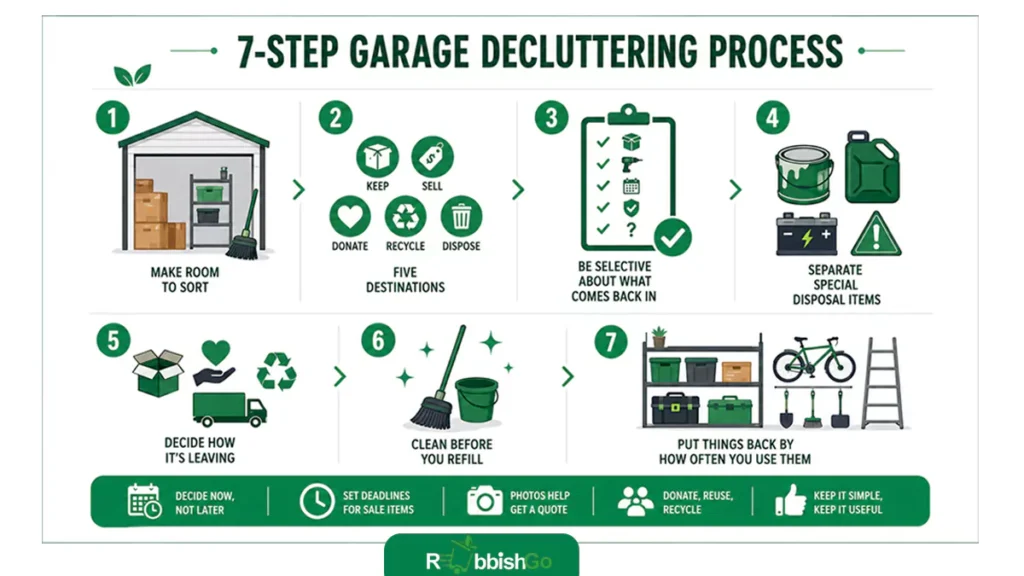
Step 1: Make Enough Room to Sort Properly
Begin with the easy wins. Flattened cartons, obvious rubbish, broken packaging and items you already know are leaving can go first. Even a small amount of cleared floor makes it easier to stand, reach shelves and sort the next batch without tripping over everything.
In a small garage, a full empty-out can be practical if you have a dry driveway or covered spot where belongings can sit safely for a few hours.
A packed double garage is usually easier to tackle in sections. Clear one corner properly, then move across the room. That way you can see progress instead of creating one enormous pile outside.
Try to make a decision the first time you pick something up. Shifting the same box from one side of the garage to the other is tiring and does not actually reduce the clutter.
Step 2: Give Everything One of Five Destinations
Five simple categories are enough. More than that tends to create piles that need another round of sorting later.
Use these five categories:
Keep
Things you use, need or can name a clear purpose for.
Sell
Items with enough resale value to make photographing, listing and dealing with buyers worthwhile.
Donate
Useful belongings that no longer suit your household but are still in good enough condition for someone else.
Recycle
Material with a genuine recycling pathway, such as clean cardboard, scrap metal and some electronics.
Dispose
Broken, damaged or unusable items that have no sensible reuse option left.
Be especially careful with the sell pile. It is very easy to turn one cluttered garage into the same cluttered garage plus a corner labelled ‘to sell’. If you are not realistically going to list an item, treat that as part of the decision now.
Give sale items a deadline. If they are still there after that date, lower the price, donate them or move them into the appropriate disposal stream.
Step 3: Be More Selective About What Comes Back In
Some choices take seconds. An empty carton or cracked storage tub is unlikely to cause much debate.
The awkward items are the usable ones that have survived several clean-outs without being touched.
A few questions can help:
- Have I used this during the past year?
- Do I own another item that does the same job?
- Would I spend money on this again today?
- Does it still work safely?
- Is there a specific reason I will need it again?
- Is the space it takes up worth keeping it?
Seasonal gear is different. Christmas decorations, camping equipment and similar items can still justify their place even if they only come out once or twice a year.
The harder category is the stuff being saved for a vague future use. If nobody can say when it will be needed, that is worth taking seriously.
Tools are a common example. A spare drill can be handy. Four partly working drills occupying half a shelf are usually just taking up half a shelf.
Step 4: Separate Anything That Needs Special Disposal
Garages often become the holding area for products that cannot go into ordinary household rubbish.
Paint, solvents, motor oil, pesticides, pool chemicals, gas bottles, fire extinguishers and batteries are common examples. If you’re unsure how to sort different types of waste, check our “Waste Classification Guidelines” before arranging disposal.
Pull those items out before you organise any general garage waste removal.
In NSW, some household chemicals can go to Community Recycling Centres or be handled through Household Chemical CleanOut services. Batteries should also stay out of normal household bins.
RubbishGo does not take hazardous chemicals, toxic materials or liquid waste as part of a standard garage clean-out. Keep those items separate and arrange the correct disposal method for them.
Step 5: Decide Exactly How the Unwanted Stuff Is Leaving
A pile marked ‘get rid of’ is still clutter if it sits beside the garage door for the next three weeks.
Give every outgoing item a real destination, not just a label.
Good furniture, tools and sporting gear may be suitable for donation. Items with real resale value can go online. Clean cardboard and suitable metals may have a recycling option. The important part is moving each group on rather than letting it settle into a new pile.
Council bulky waste services may also help with some items, depending on what your local council accepts and how its booking system works.
The job changes once there is more rubbish than you can reasonably fit in the car. Old shelving, damaged furniture, appliances, timber, boxes and general household junk can turn a straightforward garage clean up into several runs to the tip.
If the pile has reached that stage, RubbishGo can take care of the lifting, loading and garage rubbish removal across Central Coast, Newcastle and Lake Macquarie.
If the load is too big for the car, send RubbishGo a few clear photos of the garage. The team can quote on the removal before you decide whether to book.
Step 6: Clean the Empty Areas Before You Refill Them
Once you can actually see the floor and walls again, use the opportunity to clean them before the shelves fill back up.
Sweep under shelving, pull down cobwebs and wipe the dust from surfaces that may not have been accessible for years.
It is also a good time to look for damp, water entry, mould, pests, unstable shelving or cracked storage tubs. Those problems are much easier to deal with before everything is packed back in.
Step 7: Put Things Back According to How Often You Use Them
With the excess gone, how to organise a garage is far less complicated because you are only finding homes for things you have chosen to keep.
Group similar items together instead of squeezing them into whichever gap happens to be free. You should be able to guess where the extension lead, garden gloves or bike pump lives without opening six tubs.
Keep everyday gear within easy reach. Seasonal items can go higher or further back, and heavy tubs belong on lower shelves where they are safer to lift.
Wall-mounted storage can work well for bikes, ladders and some tools because it frees up floor space without making frequently used gear difficult to reach.
These garage decluttering tips are basic on purpose. A simple system that still makes sense six months later is more useful than filling the room with new storage products.
Choose a Disposal Option That Matches the Size of the Job
Two rubbish bags and an old chair are one kind of clean-out. A double garage full of shelving, furniture and boxes is another. The amount, weight and type of material will usually tell you whether DIY disposal, council collection, a skip bin or professional removal is the more practical choice.
| Option | Often useful for | Main drawback |
| DIY disposal | Small loads | You handle the lifting, transport and disposal trips |
| Council collection | Eligible bulky household items | Bookings, limits and exclusions can apply |
| Skip bin | Larger amounts of suitable waste | You still load the bin yourself |
| Professional rubbish removal | Bulky or mixed garage waste | Higher cost than doing the disposal yourself |
Taking Rubbish Away Yourself
DIY disposal is often enough for a small load, especially if you have a suitable vehicle and do not mind doing the lifting and the trip to the disposal point yourself.
Using a Council Bulky Waste Service
Council collection can suit eligible household items if the timing works for you and the items fall within your council’s limits and exclusions.
Hiring a Skip Bin
A skip bin is useful when you want a container on site for several days. The trade-off is that you still have to carry every item out and load it yourself.
Booking a Rubbish Removal Service
Full-service removal makes more sense when the main obstacle is the physical job of getting bulky or mixed rubbish out of the garage.
That is often the case with garage junk removal involving furniture, appliances, shelving and mixed household rubbish rather than one neat waste type.
For more information, you can read “Skip Bin Hire vs. Rubbish Removal Services“
If you are already counting the number of car trips or wondering whether one skip will be enough, send RubbishGo photos of the load first. You can compare the quote with the effort and cost of doing the disposal yourself before committing to anything.
How RubbishGo Handles a Garage Clean-Out
Across Central Coast, Newcastle, and Lake Macquarie, RubbishGo can handle your garage clean-out once you have sorted the garage. The service can also help with larger clear-outs where bulky rubbish has become too much to move comfortably without assistance.
Lifting and loading are part of the service, so you do not have to carry furniture, boxes and other accepted items out to a skip on your own.
1. Send Photos and a Few Basic Details
A few clear photos usually show the team how large the load is and whether access to the garage is straightforward or restricted.
2. Get a Quote for the Load
The quote can vary with the volume and weight of the rubbish, along with access conditions at the property.
3. The Team Handles the Lifting and Loading
Accepted items are carried out of the garage and loaded for removal.
4. Recyclable Material Is Separated Where Practical
Metal, cardboard, suitable e-waste and other recyclable material can be separated where an appropriate recycling option is available.
5. The Unwanted Pile Is Removed
Once the collection is finished, there is no skip left for you to fill and no second load waiting for a run to the tip.
If you have reached the last awkward pile, send RubbishGo photos of the garage for a no-obligation garage clean-out quote in Central Coast, Newcastle or Lake Macquarie.
Keep the Garage Clear Without Making It a Big Project Again
Garages rarely become cluttered overnight. They fill up a little at a time, which is good news because keeping them usable can also be done a little at a time.
Give each type of item a home and move donations, rubbish and unwanted bulky pieces out before they settle into a permanent corner.
A quick 10 or 15-minute tidy every month or two is usually enough to put loose items back, clear the floor and spot any new pile before it grows.
Use This Garage Decluttering Checklist Before You Finish
After a long cleaning day, it is tempting to leave the final few jobs for another weekend. This garage decluttering checklist is a quick way to check that the loose ends are actually dealt with.
- The garage has a clear purpose
- Obvious rubbish has been removed
- Belongings are sorted into keep, sell, donate, recycle and dispose groups
- Sale and donation items have a deadline
- Batteries and chemicals are separated
- Bulky rubbish has a disposal plan
- Floors and shelves are clean
- Similar belongings are stored together
- Boxes and tubs are labelled
- Heavy items are stored low
- Frequently used items are easy to reach
- Floor space is kept as clear as possible
Sometimes the Best Storage Fix Is Simply Having Less in the Garage
Shelving, hooks and storage tubs can only do so much. If every shelf is packed and every section of wall is carrying something, another organiser may just give you a tidier version of the same problem.
For many garages, the biggest change comes from removing things the household no longer uses rather than finding smarter ways to stack them. Keep what supports the way you actually use the space. Sell or donate items that still have value, recycle suitable material, and make a definite plan for everything else that needs to leave.
If the last pile includes old furniture, appliances, shelving, boxes or general rubbish that is difficult to move, RubbishGo provides a garage clean-up service across Central Coast, Newcastle and Lake Macquarie.
Send through a few clear photos of the garage to get a quote and confirm what can be collected.