


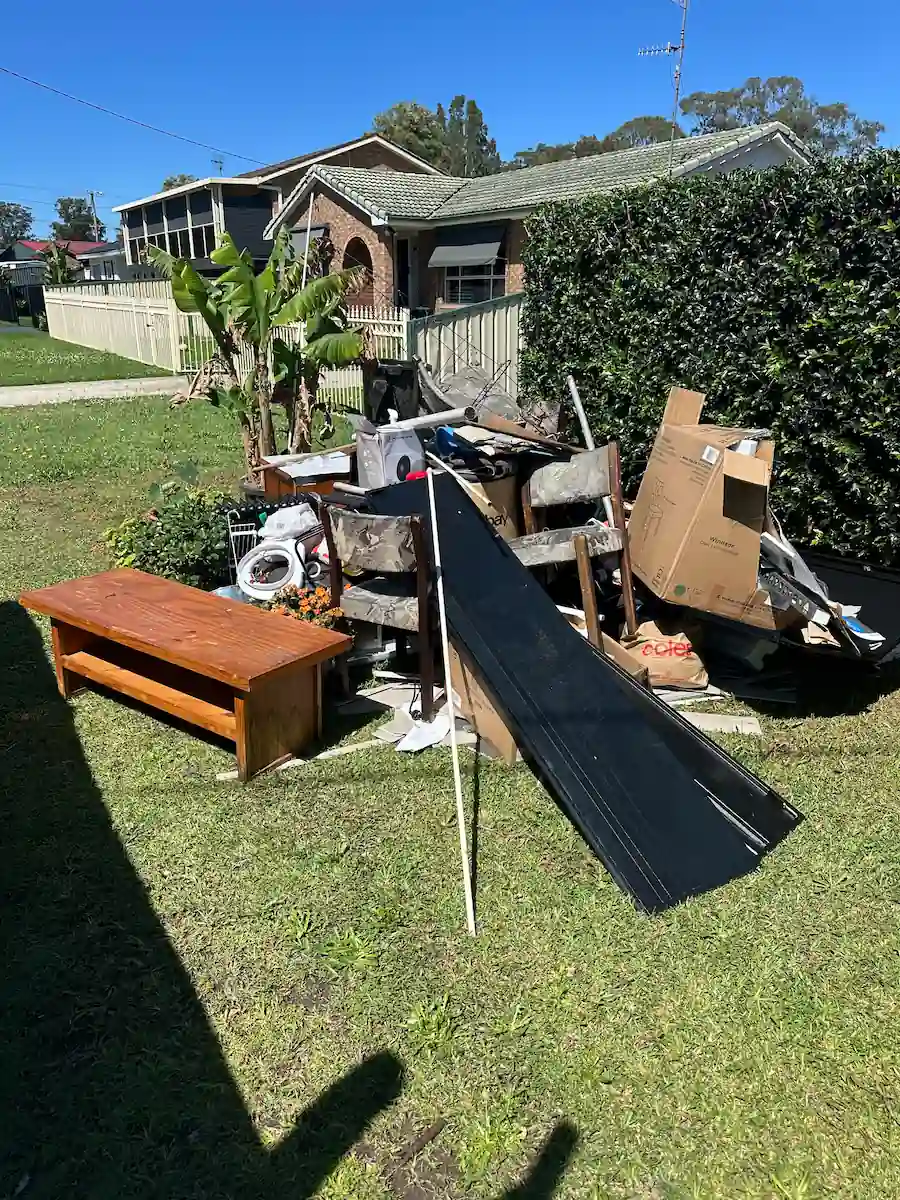
Got an old fridge sitting unused in the garage? A trailer full of renovation rubbish? Or just more household junk than the red bin can take? They don’t necessarily go to the same place.
NSW has different disposal rules for everyday rubbish, recyclables, building materials, electronics, chemicals and other problem waste. Some can go through your council service. Some need a recycling drop-off. Others have to be handled by a licensed or authorised facility.
For most people, the trick is simply knowing what you’ve got before you get rid of it.
The NSW Environment Protection Authority (EPA) sets the rules around waste classification, transport and disposal. Your local council looks after the services you’re more likely to use week to week, such as general waste, recycling, green bins and scheduled clean-ups.
Who Looks After Waste Rules in NSW?
The NSW EPA handles the state’s main waste laws. That includes the Protection of the Environment Operations Act 1997 and the Protection of the Environment Operations (Waste) Regulation 2014. These laws cover things such as where particular waste can be taken, how it is classified and, in some cases, how it must be transported or tracked.
If you’re dealing with normal household rubbish, though, you will usually spend more time checking your council website than reading EPA legislation.
Councils set their own collection arrangements, so what is accepted in a recycling or organics bin can differ from one part of NSW to another. If you’re staring at something unusual and wondering which bin it belongs in, check locally before chucking it in.
For the legal side of things, see our guide to EPA waste regulations in NSW.
How Does NSW Classify Waste?
There are six official waste classes in NSW. They sound fairly technical because, for the most part, they are designed for situations where the type of waste affects how it can legally be handled.
| Waste class | What it covers |
| Special waste | Waste subject to specific controls, including asbestos |
| Liquid waste | Waste that meets the regulatory definition of a liquid |
| Hazardous waste | Material that presents a higher risk to people or the environment |
| Restricted solid waste | Solid waste requiring tighter disposal controls |
| General solid waste – putrescible | Waste that can break down biologically |
| General solid waste – non-putrescible | General solid material that does not readily decompose |
You don’t need to stand over the kitchen bin classifying every rubbish bag.
Where the system starts to matter is with things like contaminated material, chemicals, building waste and commercial loads. That’s where putting something in the wrong stream can create a real disposal problem.
Sorting ordinary household rubbish is much simpler. Our household waste sorting guide covers the common items you’ll run into at home.
Where Does Different Rubbish Actually Go?
A bag of general rubbish is one thing. A dead TV or tin of leftover paint is another.
Here’s the rough breakdown for the types of waste most NSW households deal with:
| You’ve got | Usually goes to |
| Everyday household rubbish | Council general waste bin or rubbish collection |
| Accepted paper, glass and packaging | Council recycling |
| Lawn clippings and garden waste | Green bin or green waste collection |
| Furniture and bulky household junk | Council clean-up or rubbish removal |
| Computers, TVs and electronics | E-waste collection or recycling |
| Fridges, washers and other appliances | White goods recycling or collection |
| Renovation rubble | Suitable waste facility or renovation waste service |
| Paint, oils and household chemicals | Community Recycling Centre or approved collection point |
| Asbestos | Specialist asbestos removal and authorised disposal |
Green waste is one area where council rules can trip people up. A few lawn clippings may be fine, while large branches, logs or certain garden materials may not be.
Our green waste bin rules in NSW guide covers the bin side of it. Got a bigger pile after pruning or clearing the yard? Green waste removal may save you several trips.
A Few Waste Rules NSW Households Commonly Run Into
Most household rubbish problems aren’t especially complicated. Someone puts the wrong thing in recycling. Old paint ends up in the general rubbish. A mattress gets left on the kerb without a booked council clean-up.
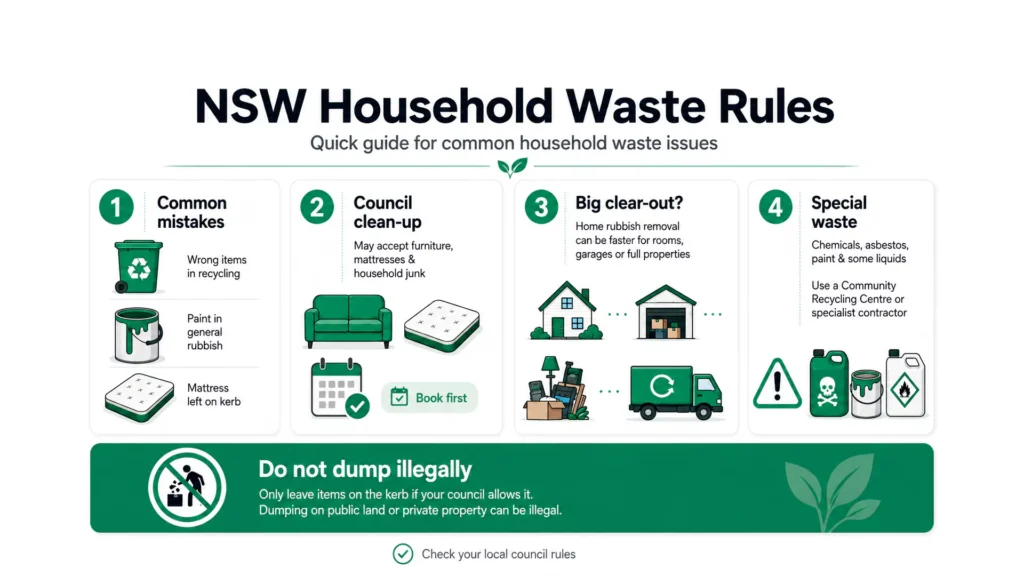
Those are the sorts of mistakes worth avoiding.
Old furniture, mattresses and general household junk may be accepted through your council’s clean-up service. If you’ve got a whole room, garage or property to clear, home rubbish removal can be quicker because the lifting and transport are handled as part of the job.
Chemicals, asbestos, paint and certain liquids are a different story. Don’t hide them in a general rubbish load. They may need a Community Recycling Centre or a specialist contractor.
And don’t leave unwanted stuff on the kerb unless your council collection actually allows it. Dumping rubbish on public land, or on someone else’s property without permission, can be treated as illegal dumping.
We’ve covered that separately in our guide to illegal dumping in NSW.
What’s Happening with FOGO in NSW?
FOGO stands for Food Organics and Garden Organics. NSW is rolling it out in stages rather than switching everyone over on the same date.
The first mandatory food-waste separation requirements for certain supermarkets, hospitality businesses and institutions started on 1 July 2026. Smaller eligible premises come into the system later.
Households are on a longer timetable. Eligible NSW homes are due to have access to a council FOGO service by 1 July 2030.
If your business falls within the rollout, food scraps can no longer simply be treated as another bag of general commercial rubbish. They need their own collection stream.
Waste Management for NSW Businesses
Walk through a busy office, café or commercial property after a clean-out and you’ll rarely find just one kind of waste. There might be cardboard stacked near the storeroom, broken furniture out the back, old monitors under a desk and general rubbish in bags.
Keeping those materials apart from the start makes the clean-up less messy.
Cardboard and paper can stay out of general waste. Old computers and monitors can be put aside for e-waste. Furniture and bulk rubbish can then be collected separately through an office rubbish removal or commercial rubbish removal service.
IT equipment is particularly worth separating. A monitor or printer isn’t just another bulky object; it contains metals and electronic components that can be recovered through the right recycling route.
For larger office clear-outs, see our office e-waste disposal guide or book electronic waste disposal.
What About Renovation and Building Waste?
Pull out an old kitchen or bathroom and the rubbish piles up quickly. Timber, plasterboard, broken tiles, bricks, cabinets, flooring, packaging; suddenly there’s far more than you’d ever fit in the household bin.
Some of those materials can be recovered or recycled, particularly metals and usable timber. Keeping them separate before collection can make that easier.
RubbishGo’s renovation waste removal service covers a range of non-hazardous renovation materials, including timber, plasterboard, tiles, bricks and old fittings.
Asbestos doesn’t belong in that load.
If you’re renovating an older property and aren’t sure what you’re looking at, deal with any suspected asbestos separately before moving or breaking it up.
There’s also more detail on different types of timber in our timber recycling and green waste rules guide.
Getting Rid of Electronics and White Goods
That broken washing machine might have been sitting beside the shed for six months, but it still shouldn’t simply disappear into a load of ordinary rubbish. The same goes for TVs, computers, monitors and printers.
Where suitable recycling is available, keeping electronics and appliances separate means useful materials have a better chance of being recovered.
RubbishGo collects smaller electronics through electronic waste disposal, while appliances such as fridges and washing machines can go through white goods removal.
Planning to get rid of an appliance that still works? Donation may also be an option.
Our white goods recycling guide runs through recycling, donation and what to do before collection.
Skip Bin or Rubbish Removal?
This mostly comes down to how you’re doing the clean-up. Renovating over the weekend and expecting rubbish to build up as you work? A skip gives you somewhere to put it as you go.
Already have a pile of junk sitting in the driveway and just want it gone? Direct rubbish removal may make more sense.
You also won’t have to load everything into the bin yourself.
There are a few other differences around access, space and the type of rubbish involved. We’ve compared them in more detail in skip bin hire vs rubbish removal.
Rubbish Removal on the Central Coast, in Newcastle and Lake Macquarie
RubbishGo isn’t a statewide NSW collection company. Our crews work across the Central Coast, Newcastle and Lake Macquarie, collecting rubbish from homes, businesses, offices and renovation sites.
Jobs can include:
- household clean-outs
- garden rubbish
- office and commercial waste
- old electronics
- white goods
- non-hazardous renovation debris
Sometimes it’s a ute-load of household junk. Sometimes it’s several rooms of office furniture. Sometimes a reno has left a stack of timber, tiles and plasterboard in the driveway.
The price depends on what we’re picking up, how much there is, how heavy it is and how easy the property is to access.
You can check our rubbish removal prices page before organising a collection.
Before You Book a Rubbish Removal Company in NSW
Don’t book purely on the promise that someone can “take everything”. Ask what everything actually means.
A decent waste collector should be able to tell you what they accept, what they don’t, whether labour is included and how the quote is calculated.
You’ll also want to know:
- whether recyclable materials are separated;
- whether there are extra charges for heavy waste;
- whether stairs or difficult access affect the price; and
- where the load will be taken after collection.
That last one matters. NSW rules require waste to end up somewhere legally able to receive it. A cheap collection isn’t much of a bargain if the rubbish is handled badly after it leaves your place.
Got a Pile You Want Gone?
Send RubbishGo a couple of photos. If you’re on the Central Coast, in Newcastle or around Lake Macquarie, we can look at what you’ve got and tell you which collection type fits the job.
Household junk, garden waste, old appliances, office rubbish and non-hazardous renovation debris can all need slightly different handling.
And if you spot asbestos, chemicals or unidentified liquids in the pile, mention them before booking. They’re not something to quietly throw underneath everything else.