


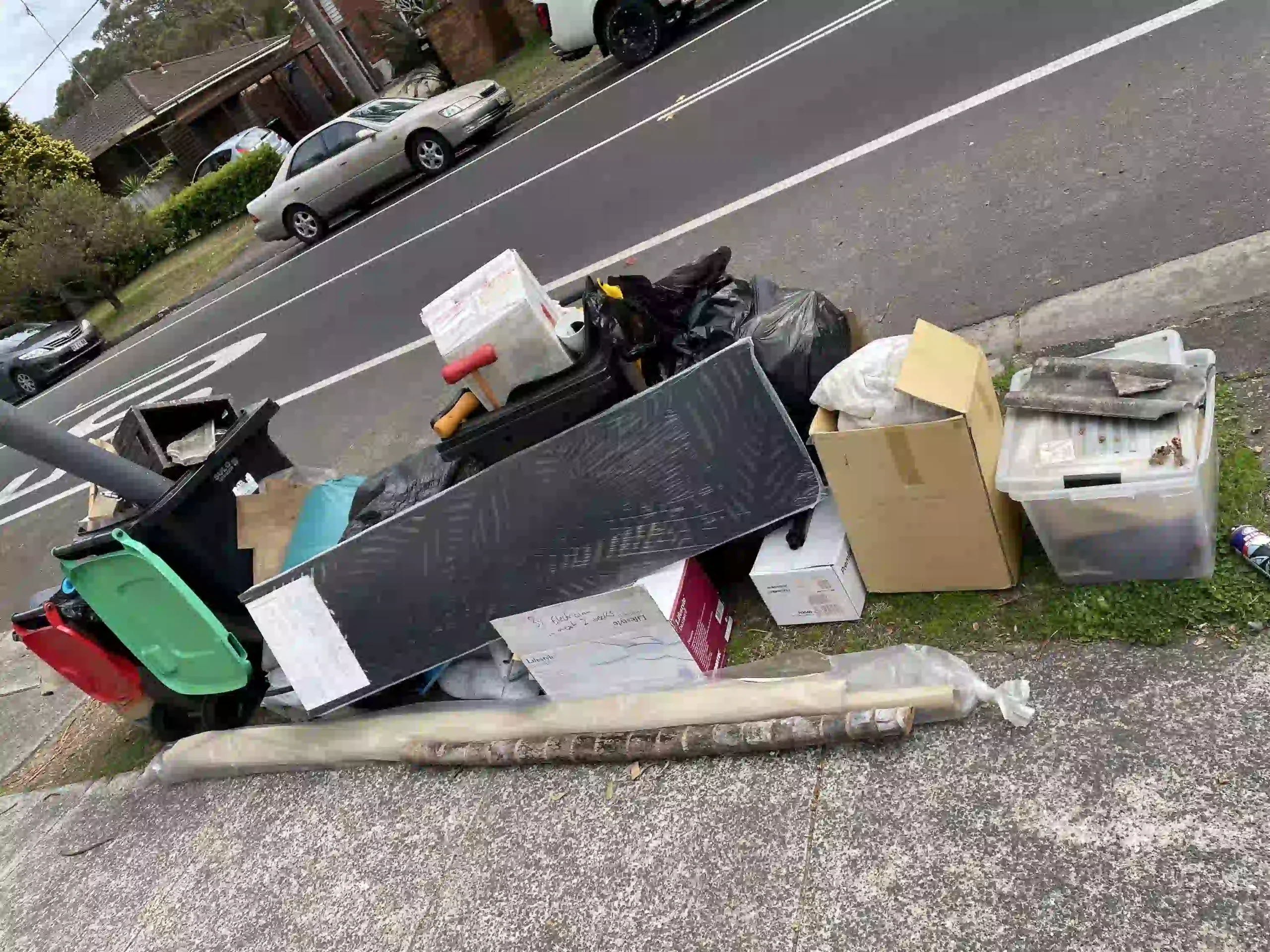
What counts as illegal dumping in NSW?
The Protection of the Environment Operations Act 1997, usually called the POEO Act, is the main NSW law governing unlawful waste disposal. It covers more than the person who physically tips a load from a ute or truck.
Sections 143 and 144 deal with transporting waste to a place that cannot lawfully receive it and using a place as a waste facility without lawful authority. Section 144AE deals with small-scale illegal dumping in public places and open private places. Land pollution, water pollution, asbestos and dangerous-material offences may apply at the same time.
Common examples of illegal dumping in NSW include:
- putting furniture, mattresses or bags of household rubbish on the kerb without a valid council collection booking;
- leaving waste outside a charity shop or donation bin when it has not been accepted;
- tipping soil, concrete, bricks, plasterboard or demolition debris on vacant land;
- emptying lawn clippings, branches or other garden waste in bushland, reserves or beside a road;
- placing trade waste in a public bin, another business’s bin or a skip without permission;
- accepting soil or “free fill” on land that is not lawfully approved to receive it; and
- dumping chemicals, oils, batteries, tyres, e-waste or asbestos outside an authorised collection or disposal route.
Permission from a landowner is not the same as legal approval to receive waste. The site must be permitted to accept that particular waste under its planning consent and, where required, its environment protection licence.
The 50-litre or 50-kilogram threshold
The section 144AE illegal dumping threshold is met when more than 50 litres or 50 kilograms of litter or waste is deposited in a public place or open private place. The volume and weight tests are alternatives: exceeding either can meet the threshold.
This does not create a free allowance below 50 litres or 50 kilograms. A smaller deposit may be prosecuted as littering. A single lithium battery, syringe, glass item, e-cigarette, or quantity of oil, fuel, grease, paint or solvent can fall under the dangerous-material littering provisions.
Other illegal dumping and waste offences do not rely on the section 144AE threshold. Transporting a load to an unlawful destination, allowing land to operate as an unlawful waste facility or causing pollution may trigger separate provisions.
Public places, open private places and sensitive places
A public place includes roads, footpaths, parks, carparks, transport stops, State forests and national parks. An open private place can include a front yard, industrial yard, farm, grazing land or privately owned vacant block that is outside a building.
Higher small-scale illegal dumping penalties apply in a sensitive place. NSW law includes national park land, State forests, council parks, beaches, waters such as creeks and stormwater channels, and the public or open grounds of a school, hospital or childcare centre. The legal definition should be checked for the exact site rather than inferred from its everyday description.
Illegal dumping fines in NSW
The phrase “fine for illegal dumping” can refer to two different things. A penalty notice is an on-the-spot fine issued without a court first determining the charge. A maximum penalty is the upper limit a court may impose after prosecution; it is not the automatic amount for every case.
The current NSW EPA illegal dumping penalties are:
| Offence | Individual | Corporation |
| Small-scale illegal dumping of more than 50 L or 50 kg in a non-sensitive public place or open private place | $1,000 penalty notice; $25,000 maximum court penalty | $5,000 penalty notice; $50,000 maximum court penalty |
| Small-scale illegal dumping of more than 50 L or 50 kg in a sensitive place | $2,500 penalty notice; $50,000 maximum court penalty | $10,000 penalty notice; $100,000 maximum court penalty |
| Larger-scale unlawful transport or depositing of waste | $15,000 penalty notice for a first offence; up to $500,000 plus $120,000 for each day a continuing offence continues | $30,000 penalty notice for a first offence; up to $2 million plus $240,000 for each day a continuing offence continues |
| Wilful disposal causing, or likely to cause, environmental harm | Up to $2 million and/or seven years’ imprisonment | Up to $10 million |
| Negligent disposal causing, or likely to cause, environmental harm | Up to $1 million and/or four years’ imprisonment | Up to $4 million |
Higher penalty notices apply to repeat larger-scale offences. Where a larger-scale strict-liability illegal dumping offence involves asbestos waste, the maximum penalties are doubled. Clean-up orders and continuing daily penalties may also apply.
The EPA reported in February 2026 that it had issued 26 penalty notices totalling $446,750 since the 2024 laws were strengthened. The same research found that 98 per cent of NSW councils regarded illegal dumping as a problem in their area, and one in seven spent more than $500,000 a year on clean-up and enforcement.
Who can be liable when somebody else takes the waste?
Section 143 can expose several parties to liability when waste is transported to a place that cannot lawfully accept it:
- the owner of the waste immediately before transport;
- the person transporting it;
- the owner of the vehicle used for transport; and
- the person or landholder accepting the waste or allowing the place to be used unlawfully.
This is the part many householders, builders and property managers miss about illegal dumping liability. A cash payment, online booking or contractor invoice proves that somebody collected the load. It does not prove where the waste went.
The EPA says waste owners may rely on a statutory defence only if they did not transport the waste and can prove that the offence arose from causes outside their control, while they took reasonable precautions and exercised due diligence. The facts matter, and advice from a contractor is not a substitute for checking the disposal chain.
For a household collection, sensible records include the collector’s business name, ABN, vehicle registration, collection date, a description or photo of the load and a receipt showing the receiving facility. Businesses and building sites need a more formal record trail.
Kerbside rubbish is a local compliance trap
Putting an item on the nature strip does not make it a council collection. Kerbside piles are a frequent form of illegal dumping, and the booking, timing, quantity and accepted-item rules vary between local government areas.
- Central Coast: eligible residents can book up to six general or green-waste bulk kerbside collections each year, subject to the council’s collection guidelines.
- Newcastle: the City of Newcastle warns that placing material on the kerb outside its booked bulk-waste service is illegal and may attract an on-the-spot fine of up to $5,000.
- Lake Macquarie: waste placed at the kerb more than 24 hours before the booked collection date is classed by the council as illegal dumping. Presenting bulky items without a booking is not permitted.
Book first, read the confirmation and place only accepted items out during the stated set-out window. If the council rejects part of the pile, remove it promptly and arrange another lawful disposal route rather than risk an illegal dumping notice.
Not every bin problem is automatically an offence under section 144AE. Recycling contamination, overfilled wheelie bins and using another person’s bin may instead be dealt with under council rules, tenancy terms, contract conditions or other laws. The volume, place, permission and surrounding facts decide which rule applies.
How households can avoid illegal dumping
The easiest way to avoid illegal dumping is to know where your waste is going before it leaves the property, from booking the right collection service to using the correct disposal option for problem items.
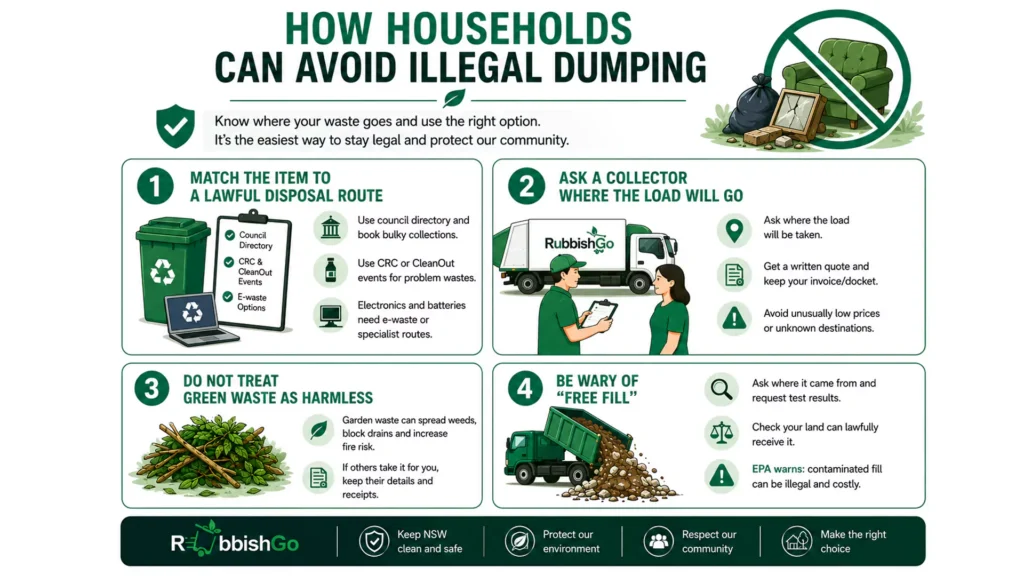
1. Match the item to a lawful disposal route
Use the council’s waste directory for ordinary household items and book bulky collection before moving anything to the kerb. Community Recycling Centres and Household Chemical CleanOut events accept specified problem wastes, often at no charge for households. Acceptance rules and quantity limits should be checked before travel.
Working electronics may be suitable for reuse; unwanted devices need an e-waste route rather than a general rubbish pile. RubbishGo’s electronic waste disposal service lists common devices collected in its service area. Battery and component acceptance can vary, while liquids, chemicals, biohazards and other excluded materials require a specialist or council-approved pathway. Check what RubbishGo collects and does not accept before booking.
2. Ask a collector where the load will go
A legitimate collector should be able to identify the proposed receiving facility and explain any exclusions. Ask for a written quote that describes the waste, then retain the invoice and disposal docket. This record trail lowers illegal dumping risk. Be cautious if a provider offers a price far below normal disposal costs, wants to remove uninspected asbestos or will not identify the destination.
RubbishGo lists its normal waste collection services for homes and businesses across the Central Coast, Newcastle and Lake Macquarie. Confirm the material type at quote stage so unsuitable or hazardous items are separated before collection.
3. Do not treat green waste as harmless
Grass clippings, palm fronds, branches and soil are still waste when taken off-site. Illegal dumping of garden waste in bushland can spread weeds and plant disease, obstruct drainage and create a fire load. If another person transports garden organics for you, the EPA recommends keeping transporter details and disposal receipts.
4. Be wary of “free fill”
Soil offered as clean fill may contain building waste, chemicals or asbestos fragments. Ask where it came from, request test results suited to the material and confirm that your land can lawfully receive it. The NSW EPA warns that a landowner who accepts contaminated fill may break the law and be left with the clean-up bill.
A waste compliance checklist for businesses and building sites
Preventing illegal dumping from a commercial site requires a traceable chain from the point of generation to a facility authorised to receive the waste. For ongoing work or construction projects, use these controls:
- Identify and classify each waste stream. Separate general solid waste, recyclable material, soil, concrete, timber, plasterboard, liquids, hazardous waste and suspected asbestos before pricing the job.
- Check the receiving facility. Confirm that its development consent and environment protection licence, where required, cover the exact waste type and quantity. An EPA licence alone does not mean a facility can accept every load.
- Write the destination into the contract. Record the facility, acceptable alternatives, subcontracting rules, rejected-load procedure and who must supply tip dockets.
- Capture transport details. Keep the business name, ABN, driver, vehicle registration, collection date and time, waste description, origin and estimated quantity.
- Keep facility evidence. Retain weighbridge dockets and receipts showing the facility’s name, address, ABN, delivery time and material received. Reconcile those records against invoices and project volumes.
- Secure the load. Vehicles and containers must prevent waste escaping. Loads generally need to be covered during transport; the EPA states limited exceptions for loads consisting solely of tyres or scrap metal.
- Apply tracking rules where required. Within NSW, a single load of 200 kilograms or more or 20 or more waste tyres, or 100 kilograms or more of asbestos waste or 10 square metres or more of asbestos sheeting, triggers reporting through the Integrated Waste Tracking Solution. Other hazardous wastes have their own tracking requirements.
- Audit subcontractors. A waste clause has little value if nobody checks the dockets. Review disposal records during the job, not months after the site has closed.
Builders, renovators and property managers can review RubbishGo’s construction waste removal service for accepted non-hazardous building materials. Suspected asbestos should be isolated and assessed by an appropriately qualified asbestos professional rather than mixed into a normal construction load.
What to do about illegal dumping on your property
Start by checking for immediate danger. Do not open bags, move drums, break sheeting or disturb material that may contain asbestos. Keep people and pets away, and record photos, the location, date, vehicle registration and witness details from a safe position.
Report the incident before arranging removal. The relevant council or EPA may need the site and waste left undisturbed long enough to collect evidence. On private land, ask the authority who is responsible for investigation and what disposal evidence will be required. Do not move the pile to the street or another property; that can create a second unlawful deposit.
If contaminated fill or hazardous waste has been delivered, obtain regulator guidance before engaging earthmoving or clean-up work. Poor handling can spread contamination and increase the remediation cost.
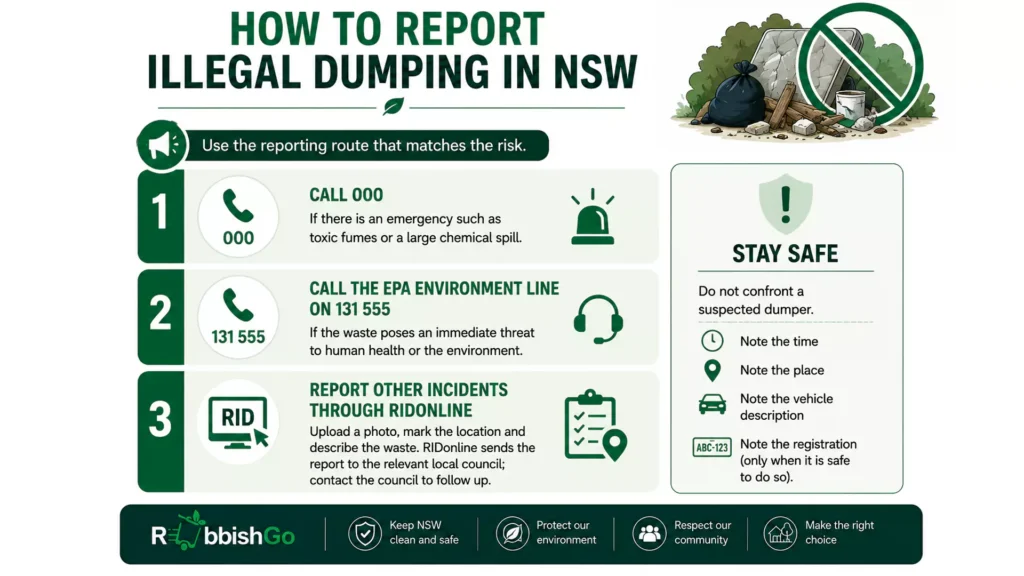
How to report illegal dumping in NSW
Use the reporting route that matches the risk:
- Call 000 if there is an emergency such as toxic fumes or a large chemical spill.
- Call the EPA Environment Line on 131 555 if the waste poses an immediate threat to human health or the environment.
- Report other incidents through RIDonline. Upload a photo, mark the location and describe the waste. RIDonline sends the report to the relevant local council; contact the council to follow up.
Do not confront a suspected dumper. Note the time, place, vehicle description and registration only when it is safe to do so.
If you receive a penalty notice or clean-up direction
Read the illegal dumping notice straight away and note the response deadline. A direction to remove waste or a clean-up notice is separate from any penalty, and ignoring it can create another offence and further daily costs.
Preserve quotes, messages, photos, invoices, vehicle details and disposal records. Do not alter a docket or ask a contractor to recreate evidence. If you dispute responsibility, face prosecution or are dealing with asbestos or contaminated land, obtain advice from a NSW lawyer or environmental consultant who can assess the notice and the evidence. This article provides general information, not legal advice.
A legal disposal trail is your best protection
The strongest protection against illegal dumping liability is a job you can account for after the truck leaves: the material was identified, the collector was recorded, the destination could lawfully receive it and the docket matches the load. That paper trail matters for a household clean-out and becomes indispensable on a building site or commercial property.
If you need collection across the Central Coast, Newcastle or Lake Macquarie, confirm the waste type and service area with RubbishGo before booking. Hazardous or excluded material should be directed to the relevant council, EPA-approved program or specialist contractor.