


Who Is Responsible for Rubbish in a NSW Rental?
Responsibility usually depends on who created the waste, when it appeared, and why a cost has been incurred.
| Situation | Who usually deals with it? | What to check |
| Normal household rubbish created by the tenant | Tenant | Council bin rules, lease and strata by-laws |
| Keeping the rental reasonably clean | Tenant | Ingoing condition report |
| Council rates and property-level charges | Landlord | Tenancy agreement and council charges |
| Excess garbage charges caused by the tenant’s use | Tenant | The actual charge and why it arose |
| Rubbish already present when the tenant moves in | Landlord or agent | Ingoing condition report and photos |
| Rubbish left by the tenant when moving out | Tenant may be liable | Outgoing condition report, photos and invoices |
| Furniture or belongings left after the tenancy | Depends on the item | NSW uncollected goods rules |
| Waste in a strata bin room or common area | Resident must follow building rules | Strata by-laws and waste procedures |
Under the Residential Tenancies Act 2010, landlords are responsible for rates, taxes and other property charges unless legislation makes a particular charge payable by the tenant.
The Act separately deals with excess garbage charges connected with a tenant’s use of the premises.
That difference matters. Normal property charges cannot simply be passed to a tenant because they involve rubbish, but an identifiable extra charge caused by the tenant can be treated differently.
What Rubbish Are Tenants Responsible For?
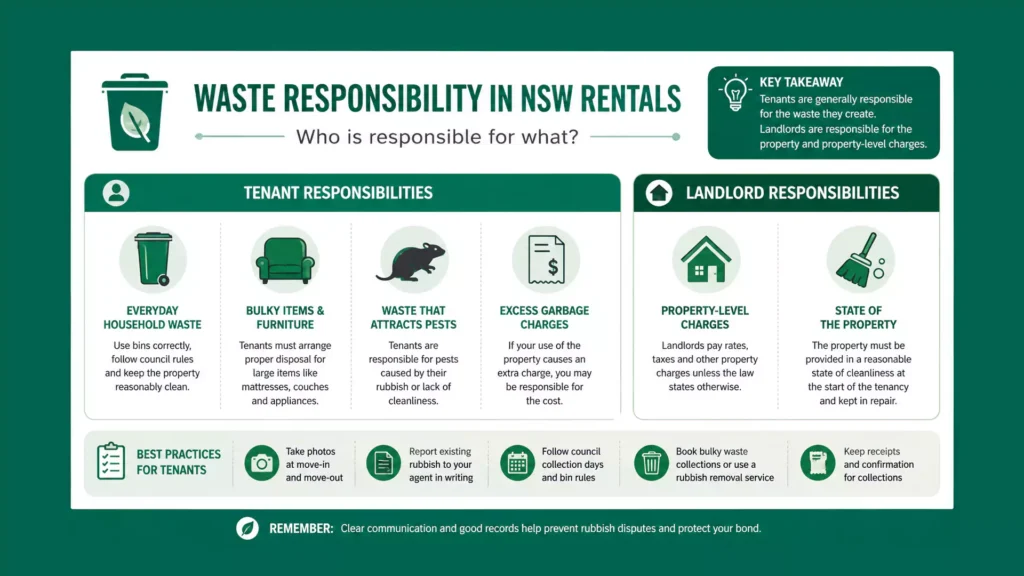
A NSW tenant is expected to keep the rental reasonably clean during the tenancy and return it in a condition close to the way it was received, allowing for fair wear and tear.
For rubbish, this mainly covers waste created through everyday use of the property.
1. Everyday household waste
Tenants would normally be expected to:
- put general waste, recycling and organics in the correct bins
- avoid routinely overfilling bins
- follow council collection instructions
- keep rubbish from accumulating inside or around the property
- use shared waste facilities correctly
- follow any strata waste rules that apply to the building
A tenant does not need to keep a rental spotless at every moment. The legal standard is based on reasonable cleanliness.
If you are unsure how different types of household rubbish should be handled, RubbishGo’s guide to waste classification and household waste separation explains the main waste categories and why correct disposal matters.
For larger household clean-outs where normal council bins are not enough, home rubbish removal can also be an option for accepted household waste and unwanted items.
2. Bulky items and unwanted furniture
A normal household bin is not designed for mattresses, couches, desks, appliances or the contents of a large move-out clean-up.
If the unwanted item belongs to the tenant, the tenant will usually need to arrange an appropriate disposal method. Depending on the area, this might involve:
- a booked council bulky waste collection
- an approved waste facility
- a private rubbish removal service
- recycling or donation where the item is suitable
Large furniture can be particularly awkward when a lease is ending and there is limited time before the final inspection. A furniture removal service can help with accepted couches, tables, bed frames and other bulky household items that need to be cleared from the property.
Leaving furniture beside the bins does not automatically count as lawful disposal.
3. Rubbish that attracts pests
Waste can also create a tenancy problem when it contributes to vermin.
NSW Fair Trading advises that tenants will generally be responsible for pest problems caused by their activities or lack of cleanliness, including situations where rubbish attracts cockroaches, ants or mice.
The cause still needs to be considered. A pest problem that existed before the tenancy or resulted from a defect in the property may fall to the landlord instead.
What Rubbish Problems Are Landlords Responsible For?
A landlord must provide the premises in a reasonable state of cleanliness at the beginning of the tenancy and keep the property in a reasonable state of repair.
That creates several situations where rubbish should not simply be treated as the current tenant’s problem.
1. Rubbish already at the property
If a new tenant arrives and finds old furniture in the garage, bags of rubbish in the yard or junk in a storage area, they should record it immediately.
The tenant should:
- photograph the rubbish before moving it
- add details to the ingoing condition report
- notify the property manager in writing
- keep copies of the photos and messages
This creates a record showing that the rubbish existed before the tenancy began.
Without that record, it can become much harder to establish who left the waste several months later.
2. Waste problems caused by the property
A waste issue can also be connected with a maintenance problem rather than the tenant’s behaviour.
A damaged bin enclosure, broken waste storage area or another defect affecting the normal use of the property should be reported to the landlord or agent.
The tenant should not automatically be expected to repair property infrastructure simply because the defect happens to involve rubbish.
Who Pays Garbage and Council Waste Charges?
This is one of the areas where tenants and landlords can easily misunderstand each other.
A landlord generally pays rates, taxes and property-level charges. NSW tenancy law separately allows a tenant to be responsible for excess garbage charges relating to their use of the residential premises.
Normal property charges
A charge attached to ownership of the property does not become the tenant’s responsibility simply because the property is rented.
Normal council rates and owner-level property charges remain with the landlord unless legislation says otherwise.
Excess garbage charges
The position may change when the tenant’s use creates a separate additional cost.
A tenant could potentially be responsible where:
- additional waste services were required because of their use
- excess rubbish resulted in an identifiable council charge
- the landlord can show that the cost relates to that tenancy
An agent asking for a generic “rubbish fee” is different from providing evidence of an actual excess garbage charge.
If money is being requested, the tenant should be able to understand what the charge relates to.
Who Has to Put the Bins Out?
There is no single arrangement that applies to every NSW rental.
Houses
At a freestanding house, putting council bins out for collection and bringing them back is commonly part of the tenant’s day-to-day use of the property.
Collection days and bin rules come from the local council.
Apartments and strata properties
Shared buildings can work differently.
Bins may be handled by:
- individual residents
- a building manager
- a caretaker
- a cleaning contractor
- a resident roster
The tenancy agreement and strata by-laws are the best places to check.
NSW tenants in strata properties must receive the applicable by-laws and are required to comply with them.
Rubbish Left at the End of a Lease
Moving out is one of the most common times for a rubbish dispute to arise.
A property may look clean inside while unwanted items are still sitting in the garage, storage cage, balcony, backyard or garden shed.
Those areas are still part of the handover.
What should be removed?
Tenants should check for:
- bags of household rubbish
- cardboard and moving boxes
- broken furniture
- unwanted appliances
- items stored in garages or sheds
- rubbish on balconies
- garden waste created during the tenancy
- unwanted items in storage cages
The property should then be compared with the ingoing condition report.
If you are planning a move, RubbishGo’s end-of-lease rubbish removal guide for NSW covers the clean-out process in more detail, including what to deal with before the final handover.
Can rubbish affect the bond?
Yes. If rubbish belonging to the tenant is left behind and reasonable removal costs are incurred, those costs can become part of a bond claim.
A landlord or agent making a bond claim without the tenant’s agreement has evidence requirements. Relevant documents can include the outgoing condition report, quotes, invoices and receipts.
Tenants should take final photos after the clean-up is complete.
Photograph areas that are easily overlooked, including the garage, shed, balcony, storage cage and outside access areas.
If a rubbish removal company was used, keep the invoice.
Rubbish and Abandoned Belongings Are Different
An item left at a rental is not automatically rubbish.
NSW rules distinguish between rubbish, perishables, personal documents and other uncollected goods.
Actual rubbish and perishables
Once the tenancy has ended, genuine rubbish and perishable items can be disposed of appropriately without the same notice period that applies to some other belongings.
This could include obvious waste such as spoiled food or ordinary household rubbish.
Personal possessions
A box containing documents, photographs, electronics or valuable belongings cannot necessarily be treated the same way as a bag of rubbish.
Different rules can apply depending on:
- what the item is
- its apparent value
- whether it contains personal documents
- how long it has been left
- whether the tenancy has legally ended
Landlords and property managers should identify what has been left before arranging a complete clearance.
NSW rules also allow certain actual costs associated with uncollected goods to be recovered, including costs connected with removal, storage and disposal.
Waste Responsibility in Strata Rentals
Rubbish becomes slightly more complicated in apartment buildings and townhouse complexes because the tenancy agreement is not the only set of rules that may apply.
Tenants living in a strata scheme must comply with the scheme’s by-laws.
Shared bin rooms
A strata scheme may have rules covering:
- recycling
- waste chutes
- shared general waste bins
- contamination of recycling bins
- oversized rubbish
- bin room access
- moving waste
- bulky item collections
Residents should follow the rules that apply to their particular building rather than assuming every apartment complex works the same way.
Rubbish in common areas
Leaving a mattress, cabinet or pile of moving rubbish in a hallway, car park or beside shared bins can create a separate problem.
Common property is controlled by the owners corporation, and abandoned goods on common property may need to be managed under NSW rules for uncollected goods.
If a resident finds abandoned rubbish in a shared area, reporting it to the strata manager or strata committee is usually better than moving it somewhere else in the building.
Can You Leave Furniture on the Kerb When Moving Out?
Not unless the local council’s rules allow it and the required collection arrangements have been made.
A council clean-up service is not the same thing as leaving unwanted furniture outside and assuming the council will eventually collect it.
Check before placing anything outside
Council systems vary across NSW. Depending on the local area, residents may need to:
- book a collection
- use designated collection dates
- follow size limits
- separate certain materials
- avoid putting prohibited items outside
A couch or mattress placed on the kerb without an approved collection can potentially be treated as illegal dumping.
If you are unsure where kerbside disposal crosses the line, read RubbishGo’s guide to illegal dumping rules and fines in NSW.
If the booked council collection takes place after the final inspection or after the keys must be returned, relying on that collection may also cause trouble with the handover.
In that situation, another lawful disposal option may be needed.
What If the Previous Tenant Left Rubbish Behind?
Do not start by throwing everything away. Take photos first.
1. Record the condition
Photograph the affected areas and record the rubbish on the ingoing condition report. Send the information to the agent or landlord in writing so there is a dated record.
This is particularly useful for:
- rubbish in garages
- items inside sheds
- furniture in storage areas
- waste in the backyard
- objects hidden in cupboards
- rubbish on balconies
2. Be careful with belongings
If the items appear to be personal possessions rather than rubbish, tell the landlord or agent.
Goods left by the previous tenant may need to be dealt with under the NSW rules for uncollected goods.
A new tenant should not be expected to decide whether somebody else’s documents or possessions can legally be thrown away.
What If You Receive a Rubbish Notice?
A tenant might receive a notice from a property manager, landlord or strata manager about waste. Read the notice carefully before deciding how to respond.
Check what the complaint is about
Look for details such as:
- the location of the rubbish
- the date it was found
- whether the notice refers to a strata by-law
- whether a council charge has been issued
- whether the rubbish has been linked specifically to your property
- whether removal is being requested
- whether payment is being demanded
If the rubbish belongs to you and the request is reasonable, dealing with it quickly can prevent a small clean-up from turning into a larger dispute. If it does not belong to you, respond in writing and keep evidence.
Photos, condition reports, council collection confirmations and dated messages are far more useful than trying to reconstruct what happened weeks later.
How to Avoid a Rubbish Dispute When Moving Out
A little planning before handover can prevent most end-of-lease rubbish problems.
A week or two before leaving
Check:
- garage
- balcony
- backyard
- shed
- storage cage
- cupboards
- side access
- under-house storage areas
Work out what can go in regular council bins and what needs another disposal method.
Large clean-ups are much easier to manage before the final day.
Before returning the keys
Once everything has been removed:
- Compare the property with the ingoing condition report.
- Walk through every storage and outdoor area.
- Take dated photos of the cleaned property.
- Keep council booking confirmations.
- Keep receipts or invoices from rubbish removal services.
A landlord or property manager benefits from the same approach. Clear records make legitimate removal costs easier to explain and help prevent claims for rubbish that was already present.
Need Rubbish Removed Before Handover?
Council bins are fine for normal weekly waste. They are less useful when a tenant needs to clear several pieces of furniture or a large amount of rubbish before a final inspection.
RubbishGo provides end-of-lease rubbish removal across the Central Coast, Newcastle and Lake Macquarie for tenants, landlords and property managers.
Collections can cover accepted household rubbish, unwanted furniture and other general waste produced during rental clean-outs.
For larger jobs, sending photos of the rubbish before collection can help establish how much needs to be removed and whether the property can be cleared before handover.
This information is general in nature. The tenancy agreement, applicable NSW legislation, local council requirements and strata by-laws should be checked where responsibility for a specific waste issue is disputed.