


What Does 1 Cubic Metre of Rubbish Look Like?
Imagine marking a square on the ground, 1 metre along each side, then building it up to a height of 1 metre. That space is 1 cubic metre (1 m³). It could hold cardboard, old clothes or broken furniture, but each would pack differently.
Wheelie bins make that number easier to picture.
| Bin or container capacity | Volume | Equivalent to 1 m³ |
| 120 L bin | 0.12 m³ | About 8.3 full bins |
| 240 L wheelie bin | 0.24 m³ | About 4.2 full bins |
| 660 L commercial bin | 0.66 m³ | About 1.5 full bins |
| 1,000 L | 1 m³ | Exactly 1 m³ |
The figures assume full bins. A half-full 240 L bin contains about 0.12 m³, not 0.24 m³.
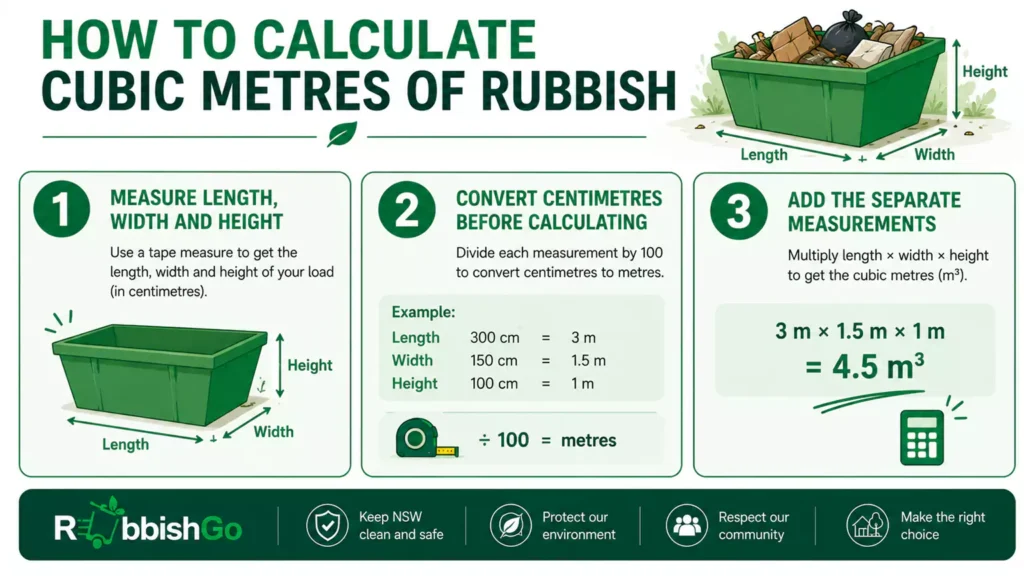
How to Calculate Cubic Metres of Rubbish
Grab a tape measure and note the outside dimensions of each pile.
1. Measure length, width and height
Measure end to end, front to back and from the floor to the top. Use metres throughout.
Length (m) × Width (m) × Height (m) = Volume (m³)
Say you’ve cleared a storage cupboard and stacked the unwanted contents against a garage wall. The stack is 1.8 m long, 1.2 m deep and 0.8 m high. Multiplying 1.8 × 1.2 × 0.8 gives 1.728 m³. Record it as about 1.7 m³.
2. Convert centimetres before calculating
If your tape shows centimetres, divide by 100 first: 75 cm becomes 0.75 m.
A carton measuring 60 cm × 40 cm × 50 cm is therefore 0.6 m × 0.4 m × 0.5 m. Its volume is 0.12 m³. Divide millimetres by 1,000. Mixing units will spoil the result.
3. Add the separate measurements
You might have 1.7 m³ in the garage, 0.6 m³ of cartons in a bedroom and a chair taking up around 0.5 m³. Add the figures to get 2.8 m³. Keep each figure in your notes in case the load changes.
What Should You Count in Your Rubbish Volume Estimate?
Count only what you’re having collected. Boxes destined for donation, working appliances you’re keeping and recycling going into your council bin should stay out of the total.
If the room is still being sorted, finish that decision first. RubbishGo’s guide to decluttering the garage offers a sensible way to separate things worth keeping from the pile that’s going out.
Measure what’s left where it sits, including anything bulky you can’t move safely.
How Do You Measure an Uneven Pile of Rubbish?
A heap of cushions can be tall in the centre and almost flat at the edges. Multiplying its maximum height across the whole footprint may count a lot of empty air.
Where the heap slopes fairly evenly, measure the height in a few places and use a rough average. For a pile that’s 2 m long, 1 m wide and about 0.5 m high on average, the estimate is 1 m³.
This approach is only an approximation, not a measured solid volume. For awkward shapes, measure 2 smaller sections instead of 1 large rectangle. Photograph the pile from the front and side.
Practical tip: Keep the original measurements when requesting a quote. Writing “roughly 1 m³ of loose garden cuttings” is more informative than rounding an uncertain estimate up to a confidently stated 2 m³.
How to Estimate the Volume of Furniture and Household Items
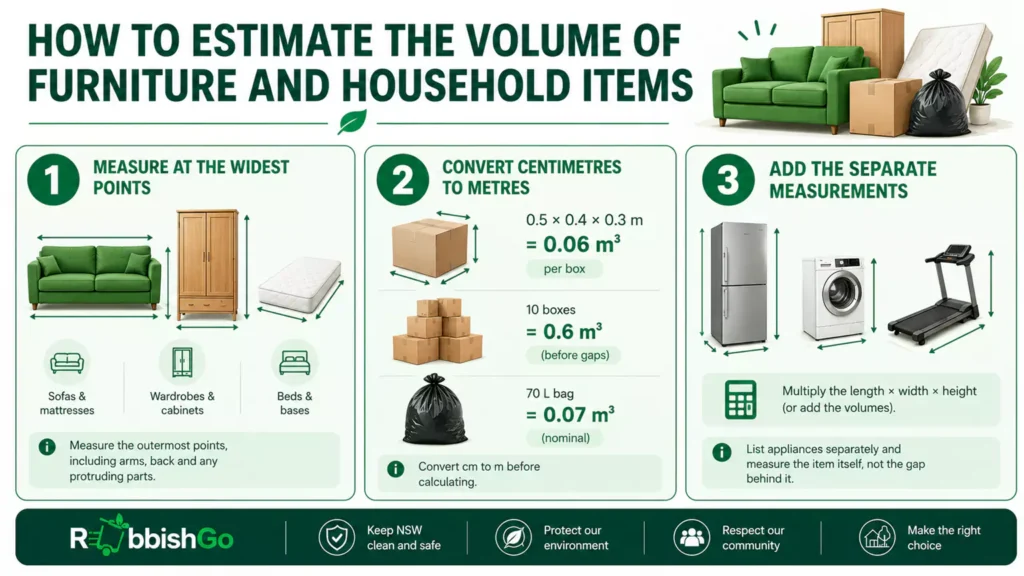
Measure furniture at its widest outside points. A hollow wardrobe still takes up space in the truck, while a sofa’s arms and back can make stacking awkward.
Sofas, wardrobes and mattresses
Measure a sofa from its outermost points, including the arms. Do the same with a wardrobe, bed base or mattress. A cabinet that’s 1.6 m high, 0.9 m wide and 0.45 m deep has a rectangular volume of 0.648 m³, or about 0.65 m³.
The loaded volume may differ. Mention if the legs or shelves are already detached, but don’t dismantle heavy furniture just to reduce your estimate.
Moving boxes and rubbish bags
Boxes are easier to add up when they’re the same size. A box measuring 0.5 m × 0.4 m × 0.3 m occupies 0.06 m³. If 10 boxes are going, they total 0.6 m³ before any gaps between them.
A 70 L bag has a nominal capacity of 0.07 m³. Underfilled bags contain less, and soft bags change shape when stacked. Count them and describe their size, or measure the whole stack if they’re together.
Whitegoods and other awkward pieces
List fridges, washing machines and treadmills separately. Measure the appliances themselves, not the gap behind them, and mention any tight doorways or stairs.
Calculating Green Waste and Building Rubbish Volume
For garden and building rubbish, write down what the pile contains as well as its size.
Branches, leaves and grass clippings
A loose tangle of branches contains plenty of air. Measure the area it occupies, and note any unusually long pieces. If branches can be cut or bundled safely before collection, they may stack differently, but don’t assume they will shrink to a particular fraction of their original size.
Bagged grass and leaves may settle. Don’t count material that’s going into your council bin. RubbishGo’s NSW green waste bin guide explains typical bin rules, which still need to be checked against your local council’s requirements.
Soil, tiles, bricks and concrete
Even a small rubble pile can be heavy. Concrete and cardboard occupying 1 m³ have the same volume, but very different weights.
List soil and bricks separately, mention if they’re wet, and check that the provider accepts them.
Safety warning: If renovation waste may contain asbestos, stop handling it and get advice from a licensed asbestos professional. Don’t break it up to make it fit, and never add suspected asbestos, chemicals or liquid waste to an ordinary rubbish load. Click here for renovation waste removalin the Central Coast, Newcastle and Lake Macquarie.
A Realistic Rubbish Volume Estimate for a House Clean-Out
A Newcastle household preparing to move out has a garage pile, 8 boxes and an unwanted bookcase.
The garage pile measures 2 m long, 1.1 m wide and 0.7 m high. That comes to 1.54 m³. Eight boxes measuring 0.5 m × 0.4 m × 0.3 m each add 0.48 m³. The bookcase, at 1.7 m × 0.7 m × 0.3 m, adds approximately 0.36 m³.
Their written estimate is 1.54 + 0.48 + 0.357 = 2.377 m³, so they’d describe it as about 2.4 m³. The bookcase is noted separately because it could be awkward to pack; the estimate isn’t a guarantee of the space used in a truck.
They check the laundry and outdoor cupboard before confirming the load. RubbishGo’s end-of-lease rubbish removal guide covers other parts of the move-out clean-up.
Why Rubbish Removal Quotes May Differ From Your Calculation
Your measured rubbish volume is a starting point, but the final quote may differ for several reasons:
- Loading space: Mattresses, furniture and branches can leave gaps in a truck, even when their measured volume is small.
- Waste weight: Bricks, soil and concrete may reach the vehicle’s weight limit before the truck is full.
- Waste type: Different materials may have different collection and disposal costs.
- Property access: Stairs, narrow gates, difficult parking and longer carrying distances can increase labour costs.
If you’re comparing collection options, RubbishGo’s skip bin hire versus rubbish removal comparison can help you decide which suits your load.
Share your measurements and photos with the collector rather than adding an arbitrary percentage for extra space.
Common Mistakes When Estimating Rubbish in Cubic Metres
These are the mistakes that most often skew a measurement:
- Using mixed units: A calculation with metres for the length and centimetres for the height won’t give a sensible cubic metre figure.
- Measuring the floor area only: A 2 m × 2 m patch tells you the area is 4 m². You still need the height to find m³.
- Counting items you’re keeping: Check the collection pile after sorting.
- Missing furniture elsewhere: That mattress in the spare room still needs measuring.
- Ignoring weight: Even a small masonry pile may need a separate load.
- Estimating too early: More rubbish may appear before moving day.
Walk through the property once more before sending the total. Storage areas are easy to miss.
Get a Rubbish Volume Estimate You Can Actually Use
Measure the piles, add separate items and describe anything heavy or difficult to access. If a heap is uneven, give an approximate figure and send photos.
For households around the Central Coast, Newcastle and Lake Macquarie, RubbishGo can assess the information you send and help you work out a suitable rubbish removal option. A clear list and a few useful photos make that first conversation much easier.